

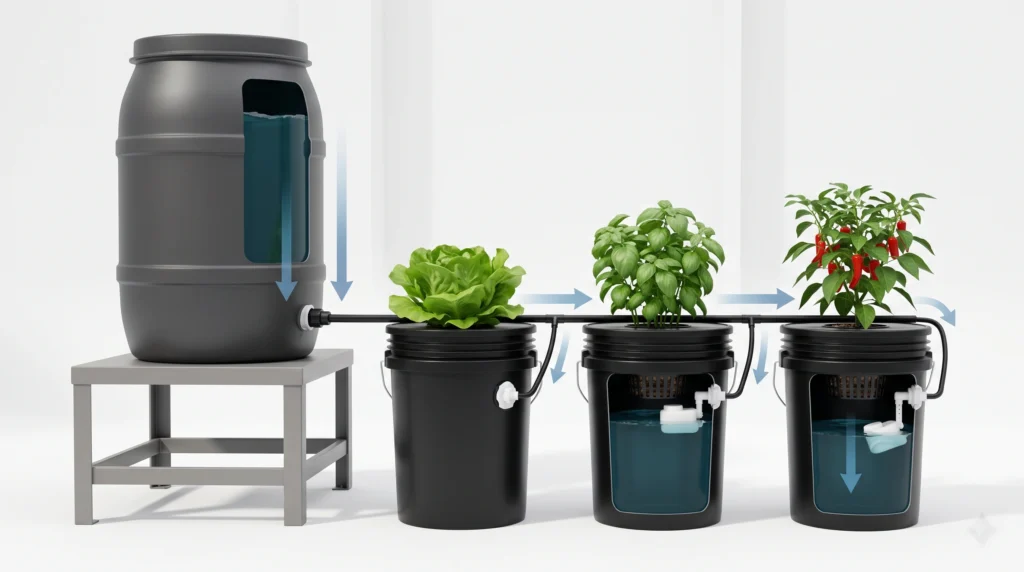
The lower third of a leafy canopy sees about 40% of top-canopy PPFD by Beer-Lambert, which is exactly what inter-canopy light between rows recovers. Rows spaced so the in-canopy bars reach mid-canopy reclaim the roughly 225 umol/m2/s a raised fixture leaves on the floor. This guide gives the row-spacing and PPFD numbers straight from the Light Coverage Architect.
Key takeaways
- Compute the average canopy PPFD as fixture PPF × count × dim × 0.9 ÷ area, scaled by the inverse-square ratio (30 cm ÷ height)².
- Size the thermal and wiring load: driver waste heat = fixture watts × (1 − eff/100), and cross-check the PPFD by dividing a lux reading by the calibration factor (~650).
- At 30 cm a 1000-µmol/s fixture throws ~900 µmol/m²/s onto a 2 m² canopy, at 60 cm only ~225.
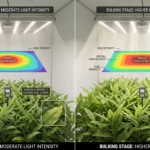
- Inter-canopy light is the difference between a top-lit and a volumetrically-lit plant: the lower third sees only about 40% of top-canopy PPFD by Beer-Lambert, and an in-canopy tower is what recovers it.
How Light Coverage Architect — Bar vs QB, Inter-Canopy & UV Blueprint Helps You Master This
- Measure the grow footprint in centimetres and convert to square metres (÷10,000), then set the fixture form-factor, count, emission PPF and mount height.
- Compute the average canopy PPFD as fixture PPF × count × dim × 0.9 ÷ area, scaled by the inverse-square ratio (30 cm ÷ height)².
- Read the uniformity from the fixture form — multi-bar ~95%, quantum board ~85% — and lift the floor by the fixture-count overlap.
- Estimate the lower-canopy hand-off with the deliberate inter-canopy fraction (~40% of top) plus any in-canopy tower flux, and the UV share kept inside the UV-A 0–10% / UV-B 0–2% window.
- Integrate the daily light integral for your photoperiod, compensating the peak for a sunrise/sunset ramp so the delivered DLI is preserved.
- Size the thermal and wiring load: driver waste heat = fixture watts × (1 − eff/100), and cross-check the PPFD by dividing a lux reading by the calibration factor (~650).
The Formula Behind the Result
Average canopy PPFD — fixture photon flux over the footprint, scaled by the inverse-square mount height → overline{PPFD} = frac{N cdot Phi_{ppf} cdot D cdot eta}{A} times left( frac{30}{h} right)^2Uniformity — multi-bar fixtures hold the ~95% floor, a quantum board ~85%, with a fixture-count overlap lift → U_{bar} approx 95% quad U_{qb} approx 85% qquad U = min(, U_{fx} + (N-1) cdot 1.5,, 99.5%)Coverage area — the footprint your fixtures can hold at the working target PPFD → A_{cover} = frac{N cdot Phi_{ppf} cdot D cdot eta}{PPFD_{target}}Inter-canopy PPFD — the lower third receives ~40% of top light; an in-canopy tower adds its own flux → PPFD_{inter} = overline{PPFD} cdot 0.40 ; + ; (text{inter-canopy} , ? , 200 : 0)UV contribution — UV share of the run as PPFD, held inside the UV-A and UV-B safety window → PPFD_{UV} = overline{PPFD} cdot frac{UV%}{100} qquad (text{UV-A } 0!-!10%,,; text{UV-B } 0!-!2%)Daily light integral — average PPFD over the photoperiod; the dimmed fixture arc averages 2/π of its peak under a sine daylight curve → DLI = overline{PPFD} cdot frac{h_{photo} cdot 3600}{10^6} qquad Phi_{dim} = Phi cdot frac{D}{100} cdot frac{2}{pi}Dimming compensation — a sunrise/sunset ramp averages ~50% of peak, so the peak must rise to hold the same DLI → PPFD_{peak} = frac{PPFD_{flat} cdot t_{total}}{t_{total} - 0.5 cdot t_{ramp}} qquad t_{ramp} = t_{dawn} + t_{dusk}Driver heat and calibration — rejected watts from driver efficiency, BTU/h, and the lux÷factor PAR-meter hand-off → Q_{driver} = V_{w} cdot (1 - tfrac{eta_{eff}}{100}) qquad Q_{BTU} = Q_{driver} cdot 3.41214 qquad PPFD = frac{lux}{655}
Target Ranges: What the Numbers Should Be
- Multi-bar LED fixtures hold a roughly 95% uniformity floor across the footprint; a single quantum board concentrates heat and photons into a center hotspot and settles nearer 85% — the difference is exactly the falloff you see at the edges.
- The inverse-square law rules coverage: double the mount height and the on-target PPFD quarters. At 30 cm a 1000-µmol/s fixture throws ~900 µmol/m²/s onto a 2 m² canopy, at 60 cm only ~225.
- Inter-canopy light is the difference between a top-lit and a volumetrically-lit plant: the lower third sees only about 40% of top-canopy PPFD by Beer-Lambert, and an in-canopy tower is what recovers it.
- UV is a finishing tool, not a main source: hold UV-A near 0–10% and UV-B at 0–2% of the photoperiod in flower only, and ramp it up over days — resin, terpenes and pest defense respond, but stress and bleaching do too.
- Adding a sunrise/sunset ramp carves about half of peak per ramp, so the controller must raise the peak PPFD to keep the same total DLI — the compensation arm returns exactly that peak and its percent increase.
Use the free Nutrient Cost Optimizer — Bulk Mixing & Recycling Blueprint to run the numbers on your own setup.
Use the free CO2 Enrichment & HVAC Engine to run the numbers on your own setup.
Use the free Mist Culture Dashboard Finalizer 32 Tools Hub + Quizzes + 365 Posts to run the numbers on your own setup.
Compare every free calculator side-by-side on the MistCulture tools hub — each one keeps your workspace in sync.
Related guides
Setting row spacing for inter-canopy bars
Inter-canopy light repairs the volume. The lower third sees about 40% of top-canopy PPFD by Beer-Lambert, so on a 900 umol/m2/s top run the lower canopy sits near 360; adding a 200-umol/m2/s in-canopy bar lifts that floor to about 560. Row spacing follows the uniformity arithmetic – every added fixture lifts the floor about 1.5% (cap 99.5%) – so bars hung to reach mid-canopy repay in recovered lower-third PPFD.
- Beer-Lambert floor: lower third about 40% of top – 900 x 0.40 gives about 360 umol/m2/s at that depth.
- Recovery line: PPFD-inter = top x 0.40 + bar flux – 900 x 0.40 + 200 gives about 560 with an in-canopy bar.
- Row spacing: each added fixture lifts uniformity about 1.5% (U = U-fx + (N – 1) x 1.5, cap 99.5%).
- Hold UV-A 0-10% and UV-B 0-2% in finishing windows so stress lands on resin, not bleaching.
Frequently Asked Questions
References & Science
- USDA National Agricultural Library
- Purdue Extension — hydroponics guide
- Cornell CALS — hydroponic research manual
Frequently asked questions
How do I set up inter-canopy coverage correctly?
Space rows so the bars reach mid-canopy and read the coverage map: the lower third sees about 40% of top PPFD, and PPFD-inter = top x 0.40 + in-canopy flux. A 200-umol/m2/s bar under a 900 top lifts the floor to about 560.
What is the biggest mistake with inter-canopy coverage?
Treating it as a top-light upgrade. Every extra fixture lifts uniformity by about 1.5% (cap 99.5%), not the top-canopy PPFD – the win is volumetric, on the lower third that Beer-Lambert starves.
Which tools help me plan inter-canopy coverage?
The Light Coverage Architect and the related PPFD 20% drop rule guide in this hub – set form-factor, PPF per bar and row geometry and read the inter-canopy hand-off of about 40% of top light.
References
- Michigan State University Floriculture — Daily Light Integral reference tables
- Bugbee, B. — Toward an optimal spectral quality for plant growth and development (USU)
- USDA NIFA — controlled environment horticulture lighting guidelines


Start the discussion
No comments yet — your grow-room experience is the first data point.