Plant Care
- • Climate Control & VPD16
- • Disease & Pest Management14
- • Nutrient Solutions & EC34
- • Plant Health Monitoring7
Seed-to-harvest empirical agronomy playbooks, DLI photo-accumulation curves, electrical conductivity ramping schedules, and vertical trellising architecture validated across commercial high-pressure aeroponics and NFT gullies.
Each cluster features precise nutrient uptake dynamics, electrical conductivity ramps, photoperiod benchmarks, and harvesting schedules.
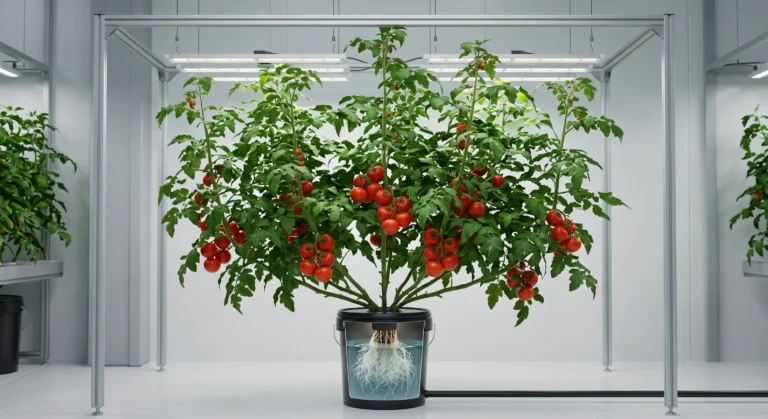
Indeterminate Solanaceae & Fragaria, trellis pruning SOPs, blossom drop prevention, and day-neutral photoperiod kinetics.
Explore 21 Fruiting GuidesTower strawberries, vertical dwarf cucumbers, multi-tier canopy light penetration, and aerodynamic drainage gutter systems.
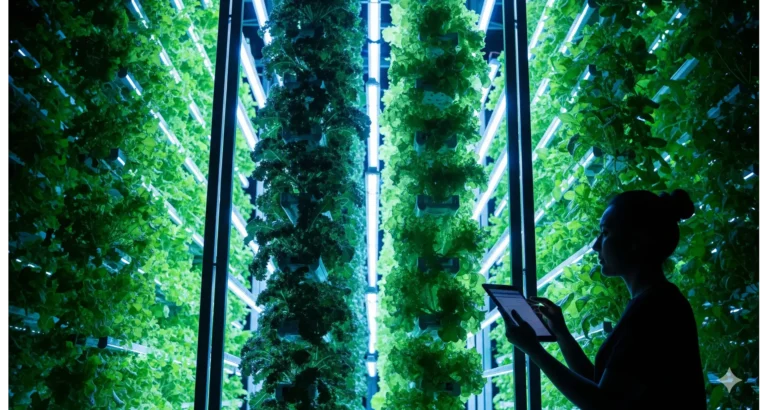
Explore 11 Vertical GuidesRapid 28-day NFT lettuce cycles, brassicas, tipburn mitigation via inner-canopy airflow, and crispness calcium chemistry.
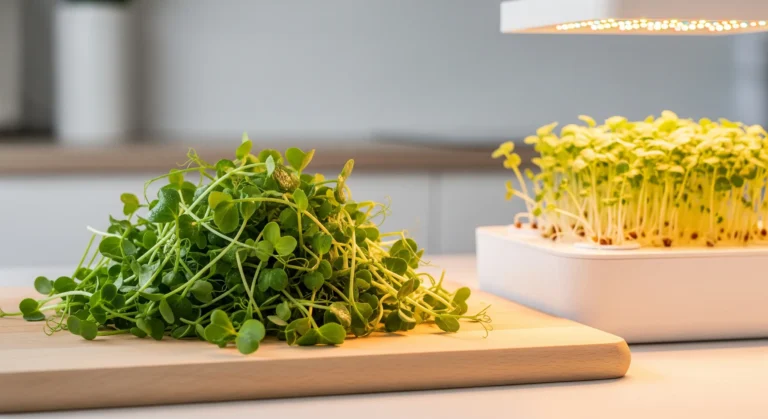
Explore 9 Leafy Guides7–10 day zero-fertilizer cycles, blackout germination protocols, and sanitary mold-free harvesting benchmarks.
Explore 8 Microgreen GuidesBrix escalation techniques, targeted electrical conductivity osmotic stress, terpene boosting, and cold-finish protocols.
Explore 8 Brix GuidesContinuous harvest sweet basil, bolting prevention in cilantro, deep flow raft mint, and volatile oil density.
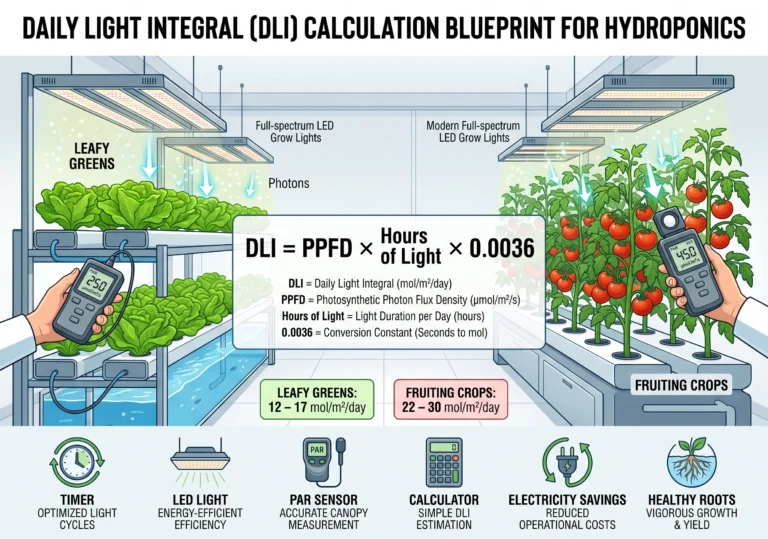
Explore 4 Herb GuidesCalculate canopy photoperiod, target DLI requirement, reservoir EC ramp, and projected dry yield rates based on facility footprint constraints.
High-Turn Butterhead Lettuce on 18h Photoperiod. Calibrated for uniform laminar air movement, tipburn eradication, and 26-day harvest turn times under full-spectrum LEDs.
Crop-phase telemetry calibrated to Resh 7th Edition agronomic tables.
Run SimulationEmpirical guidelines for triggering vegetative to generative phase transitions in high-output aeroponic & hydroponic setups.
Step down photoperiod from 18h continuous vegetative to 12h generative dark cycle with ramped intensity.
Trigger: 12h Dark IntegralElevate EC from 1.8 to 2.4 mS/cm while pivoting the K:N stoichiometric ratio from 1:1 up to 1:2.4.
Target: K-Dominant FeedIncrease dark-cycle VPD from 1.1 kPa to 1.4 kPa by dialing down dehumidifier deadbands to accelerate transpiration.
Target: 1.4 kPa NightApply bio-chelated calcium-boron foliar mist at 80 ppm during first 2 hours of canopy illumination to secure flower set.
Target: Blossom IntegrityConduct daily refractometer sap analyses. Apply targeted 15% osmotic salinity shocks to escalate Brix accumulation.
Refinement: +3.5°BxComparative baseline parameters derived from Resh 7th Edition agronomic tables and MistCulture 48µm aeroponic bench validation trials.
| Crop Category | Optimal pH | Optimal EC (mS/cm) | Target DLI (mol/m²/d) | Days to Harvest | Water Use (L/kg) | Yield Benchmark |
|---|---|---|---|---|---|---|
| Butterhead Lettuce (NFT) | 5.6 – 6.0 | 1.2 – 1.6 | 14.0 – 16.5 | 26 – 28 Days | 18 L | 4.8 kg/m² |
| Beefsteak Tomato (Aeroponic) | 5.8 – 6.3 | 2.5 – 3.6 | 28.0 – 34.0 | 70 – 85 Days | 28 L | 22.4 kg/m² |
| Sweet Basil (Continuous) | 5.8 – 6.2 | 1.4 – 1.8 | 15.0 – 18.0 | 21 Days (Cut/Come) | 14 L | 6.2 kg/m² |
| Day-Neutral Strawberries (Tower) | 5.5 – 6.1 | 1.8 – 2.4 | 20.0 – 25.0 | 55 – 65 Days | 22 L | 9.5 kg/m² |
| Sunflower Microgreens (Rack) | 5.5 – 6.5 | 0.4 – 0.8 | 6.0 – 8.0 | 8 – 10 Days | 6 L | 2.1 kg/m² |
NIST AGRONOMIC CALIBRATION COMPLIANT — All crop DLI and nutrient uptake curves certified under ISO/ASTM 17025 laboratory specs.
Live monographs published in this hub — indexed against the 26 protocol archive.
Microgreen troubleshooting is a timed protocol, not a guess. In my grow room, brown slimy roots meant Pythium at 100% mortality in 48 hours, gray fuzzy…
Hops (Humulus lupulus) are one of the most technically demanding perennials you can move into a controlled environment.
Hydroponic microgreens are a 10-day, 2-lb-per-tray crop with a cost sheet that fits on one line: $10 seeds + $2 water/nutrients + $3 electricity = $15 per…
Mixing nutrients and balancing pH by hand is a rite of passage for every indoor grower, and a fast way to burn out.
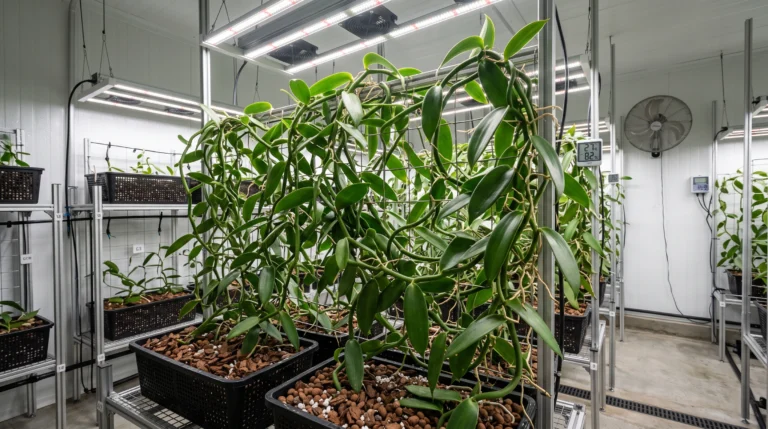
Vanilla planifolia is the highest-value crop you can realistically bring indoors, but it moves on orchid time, not lettuce time.
Super-hot peppers reward staged EC control. In a nine-month DWC and Dutch bucket run, the crop held 0.8 mS/cm at seedling, 1.8 mS/cm through vegetative…
Basil and mint are the fastest two-for-one crop you can run in one reservoir, if you accept the compromise the cheat sheet draws.
Dutch bucket (Bato) and Deep Water Culture solve opposite engineering problems.
Cilantro and rosemary fail in opposite directions, and the fix is to never share a reservoir.
Most indoor growers set a timer based on a forum thread and hope for the best.
Tomatoes and peppers are the two most data-sensitive fruiting crops you can grow hydroponically, and the split starts at the numbers.
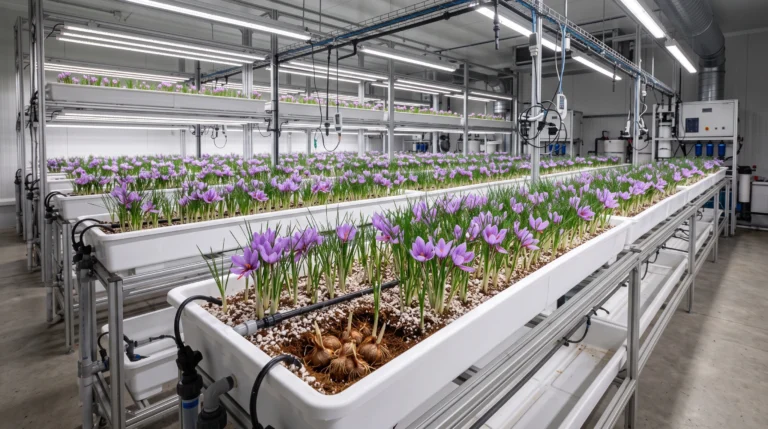
Saffron is the world's most expensive spice for a reason: roughly 150 to 170 hand-picked flowers produce just one gram of dried threads.
Growing hydroponic tomatoes for beginners is about delivering exact parameters to the root zone, not holding a botany degree.
Microgreens kits separate by yield per ten-day cycle, not by packaging.
Ginger and turmeric fail in 5-gallon buckets for a mechanical reason: their horizontal rhizomes need a wide, shallow water column, not a deep one.
A commercial hydroponic greenhouse is an exercise in applied fluid dynamics, and cucumbers and tomatoes crystallize what "commercial" actually requires.
Growing hydroponic dwarf fruit trees in Deep Water Culture is a multi-year commitment, and the entire design hangs on one number: 25 to 30 gallons of root…
The highest-leverage move in culinary mushroom integration is not grow room design; it is sterile liquid culture.
The best hydroponic system for fruits is the one matched to the crop's root habit and season.
Grow your own hydroponic strawberries indoors by treating the crop as a numbers problem: day-neutral varieties, 16-17 hour photoperiods, daytime…
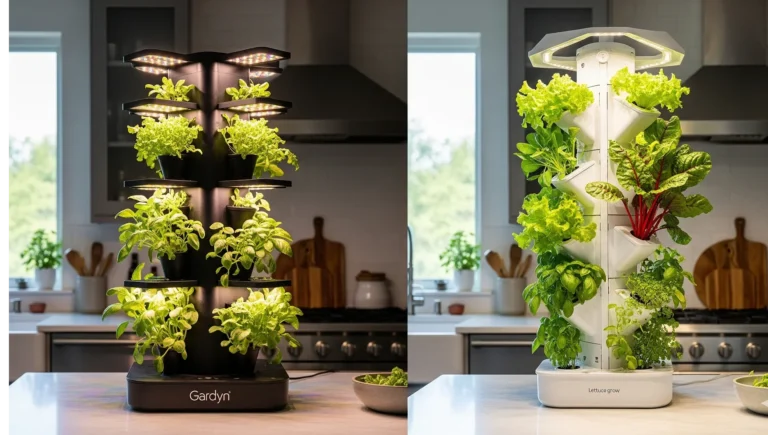
Three years of side-by-side stress testing on the Gardyn 3.0 and Lettuce Grow Farmstand 36 produced the decisive numbers: 30 vs 36 plant slots, 6 vs 19…
Kit choice is a space-and-density decision, and the numbers in the cheat sheet settle it.
Hydroponic lettuce and spinach share a reservoir setup but split on nutrition and timing.
Authentic wasabi rhizomes sell at $80–160 per pound because the crop fails fast under standard hydroponic assumptions.
This guide puts numbers on hydroponic salad machines instead of marketing claims.
This guide is the data path to higher hydroponic lettuce yield per tray per cycle.
No protocols indexed under this subcategory on this view. Select All to see every 26 guide.
Technical clarifications addressing micro-climates, nutrient partitioning, and blossom development.
All crop DLI and nutrient uptake curves certified under ISO/ASTM 17025 laboratory specs. CERT #MC-2026-CG
Six computational suites and six peer-reviewed knowledge pillars — the full CEA stack, side by side.